
Friday, October 12, 2012

Thursday, October 11, 2012
Photo Essay: William Pei (42852684) & James Stubbs Grigoriou (42797411)
Theme: Light
Sub-Theme: Artificial Light
We chose artificial light as our theme because we believe it
epitomizes the concept of ‘everydayness’. Everydayness is the idea that by
focusing on the things around us, exploring the mundane through photography, we
can capture things the human eye fails to see. An everyday image is defined by
Susan Murray in her article Digital Images, Photo Sharing, and Our Shifting Notions of
Everyday Aesthetics as: “the types of images that
we can create or engage with on a regular basis that evoke or reference the
more ordinary or frequent moments of our lives” (2008, p. 151).
Light is a necessity in our world, mans ability to control light is one of his greatest achievements, one which modern society is based around. We found it intriguing that something so pivotal could also be so mundane. As humans we fear the darkness, the unknown. We increased blacks/shadows in editing to increase the contrast between the lights and surrounding darkness to emphasize this idea. We also increased the contrast and saturation of the pictures to add to this effect. We used cross fades for slide transitions to give the feeling as though each slide was a light being turned on.
The music was chosen due to its ambient and electric feel. We thought this fitted in nicely with artificial lights. It was also selected because of it’s haunting sound for the second half of the video. We accompanied this haunting sound with images outside the house, images that expressed a feeling of isolation and darkness; this was intended to be in contrast to the bright photos at the beginning of the clip (which were much lighter cheerier). We also slowed down the video in the second half to accentuate the unsettling feeling of the pictures/music.
Light is a necessity in our world, mans ability to control light is one of his greatest achievements, one which modern society is based around. We found it intriguing that something so pivotal could also be so mundane. As humans we fear the darkness, the unknown. We increased blacks/shadows in editing to increase the contrast between the lights and surrounding darkness to emphasize this idea. We also increased the contrast and saturation of the pictures to add to this effect. We used cross fades for slide transitions to give the feeling as though each slide was a light being turned on.
The music was chosen due to its ambient and electric feel. We thought this fitted in nicely with artificial lights. It was also selected because of it’s haunting sound for the second half of the video. We accompanied this haunting sound with images outside the house, images that expressed a feeling of isolation and darkness; this was intended to be in contrast to the bright photos at the beginning of the clip (which were much lighter cheerier). We also slowed down the video in the second half to accentuate the unsettling feeling of the pictures/music.
Bibliography
Music- "The Flight (496 Km)" by Vulturius Maestus
Available at: http://www.jamendo.com/en/track/513480/vulturius-maestus-the-flight-496-km
Published under a creative commons:
Attribution-NonCommercial-ShareAlike 3.0 Unported
http://creativecommons.org/licenses/by-nc-sa/3.0/ accessed 11/10/2012
Murray, S (2008) Digital Image, Photo Sharing, and Our Shifting Notions of Everyday Aesthetics in Journal of Visual Culture Vol 7(2) pp. 147-163.
Murray, S (2008) Digital Image, Photo Sharing, and Our Shifting Notions of Everyday Aesthetics in Journal of Visual Culture Vol 7(2) pp. 147-163.
Wednesday, October 10, 2012
Photo Essay:Street Signs - Paola Dominguez 42937256 Tara Aguiar 42875943
Our theme, Street Signs, reflects the notion of the ‘everyday
aesthetics’ by showing how society is ordered and follows rules and
regulations, and how these conventions are addressing us how to behave. It also
displays how we branch away from them.
As Susan Murray
describes in her article Digital Images,
Photo Sharing, and Our Shifting Notions of Everyday Aesthetics: “the everyday
image, as it has become less about the special or rarefied moments of domestic
living and more about an immediate…and framing of the small and mundane”(2008, pp.
147). This quote can highlight how street signs, usually mundane, can be
now be seen though a different perspective, showing how something from the “everyday”
can become something more distinctive, allowing the viewer to discover the
particular aesthetic within the entity.
An example of how signs can transform from the mundane to
the distinct can be seen in the sign displayed at 0:11. This street sign
displays how society, through all its structure and order, shows a sense of
originality and expression through the use of graffiti, or in this case posters
and stickers. We can also see how signs are made to stand out and grab a person’s
attention (as displayed in 0:03). This drawing of the eye exhibits how signs
try to step out of the everyday environment to either warn, direct, or notify those
around it to its presence.
Bibliography:
Music – “VA Riding (Single Edit)” by DJ Harrison Available
at “http://freemusicarchive.org/music/DJ_Harrison/DanceRevolution/06_-VA_Riding_Single_Edit.
Published under a Creative Commons
Attribution-NonComercial-NonDerivs3.0Unported CC BY-NC-TND3.0 Accessed 9.10.12
Murray, S (2008) Digital Image, Photo Sharing, and Our
Shifting Notions of Everyday Aesthetics in Journal of Visual Culture Vol 7(2)
pp. 147-163.
Monday, October 8, 2012
Music –
“Runaway By The Past” courtesy of PeerGynt Lobogris: Available at http://www.jamendo.com/en/track/596332/runaway-by-the-past, published under a Creative Commons Attribution, NonCommercial, ShareAlike 3.0 Unported Licence, http://creativecommons.org/licenses/by-nc-sa/3.0/, accessed 5.10.12
n.b. If you use share alike media you have to publish share alike yourself
n.b. If you use share alike media you have to publish share alike yourself
Friday, August 31, 2012
Assesment Task 1 : Tara Aguiar 42875943
Media Convergence
If you look back not even 10 years ago, it can be seen how
much technology has advanced in just the past decade. This advancement in
technology has shaped how we conduct our lives, and how the media plays its
role in it. This “Convergence” has allowed society to interact electronically
with the outside world, allowing perceptions to change.
“Convergence is never just a technological process but is implicated
in, and expressed as, profound and ongoing social, cultural and economic
change.” (Dwyer, p. 8, 2010)
 This displays how influential the change in technology has
in society, and thus how the media uses this to their advantage, thus the term “Media
Convergence.” This term depicts how the
media industry has attempted to merge both “old and new technologies …referencing
the intersection of distinct media and information technology systems which had
previously been thought of as separate and self-contained” (Dwyer, p.2, 2010).
This displays how influential the change in technology has
in society, and thus how the media uses this to their advantage, thus the term “Media
Convergence.” This term depicts how the
media industry has attempted to merge both “old and new technologies …referencing
the intersection of distinct media and information technology systems which had
previously been thought of as separate and self-contained” (Dwyer, p.2, 2010).
An example of such a shifting Industry would be the Music business.
Not only has the way we listen to music changed, but the way we consume and
view it as well. We no longer live in an age where the only way to listen to
our favourite song was to hope that the radio would play it, or go to a music
store to buy the single or album. We now download music from iTunes, or look
through Torrents for the latest music and other media. Society became a place
where “every important story gets told, every brand gets sold, and every
consumer gets courted across multiple media platforms.” (Jenkins, p. 3 2006).
When you hear the term
music video, we now tend to think of the internet and YouTube as a source to
view and obtain these pieces of visual music, but before this television shows
such as MTV, [V], GTK, Countdown and Rage were the only source in which to view
these visual acts of music. This technological progress from Analogue (Physical
media such as film negative paper and vinyl records) to Digital (the 1s and 0s
of a computer system). This shows how both music and video have become simply
just lines of computerised code which can be manipulated to fit the audience it
is produced for (Aoun, pp 166).

MTV, now known more for its
reality shows than its music, used to be the “hybrid of rock music and film
imagery” (Baxter, 1985). It was the stepping stone for many famous music videos
such as Thriller by Michael Jackson; Video killed the radio star by the Buggles
and Tusk by Fleetwood Mac. This widely popular show broadcasted many music
videos and helped change the view of music forever. Now a shadow of its former glory, MTV no
longer hosts many music videos, despite having its own channel on cable
television. The new way for the audience to view visual music is now through
the internet and YouTube. This cultural shift as consumers between old
technologies and new information allows us to make connections among dispersed
media content. “This circulation of
media content – across different media systems, competing media economies, and
national borders – depends heavily on consumers’ active participation”
(Jenkins, 2006).
Youtube, and other
online media broadcasters such as vevo and Netflix, allow consumers to view these
visual productions free without any charge. As Aoun states in his article iPod and YouTube and
everyone we know:
“We
only need to look at the words…YouTube…The ‘You’ attempts to acknowledge other
talking heads and persons.” (Aoun, 2007)
This quote depicts how
YouTube draws in their audience, by allowing them to “acknowledge other talking
heads and persons” and thus sharing and circulating the media content to cause
the convergence it aims to achieve through “active participation.”
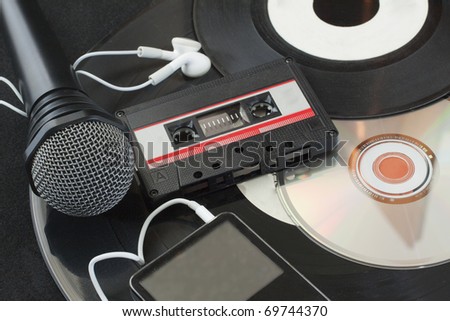 Nicholas Negroponte
(cited by Jenkins, 2006) stated that “What will happen to broadcast television over
the next five years is so phenomenal that it’s difficult to comprehend.” This
is true for any form of technology or media. This can be seen by how everything has begun
to be “digitized” the “old-fashioned” paperback book will no longer be in
print, only to be taken over by e-readers. In the Music industry it is more
prominent. We can see the quickly shifting developments of technology and how
music was quickly adapted to fit each style. First it was live and then came the vinyl
records, the floppy disc, the CD, the mini disc, the usb, the iPod and now the
internet on-the-go through media websites such as YouTube.
Nicholas Negroponte
(cited by Jenkins, 2006) stated that “What will happen to broadcast television over
the next five years is so phenomenal that it’s difficult to comprehend.” This
is true for any form of technology or media. This can be seen by how everything has begun
to be “digitized” the “old-fashioned” paperback book will no longer be in
print, only to be taken over by e-readers. In the Music industry it is more
prominent. We can see the quickly shifting developments of technology and how
music was quickly adapted to fit each style. First it was live and then came the vinyl
records, the floppy disc, the CD, the mini disc, the usb, the iPod and now the
internet on-the-go through media websites such as YouTube.
The internet brings “the
flow of media more fully under the control…. Of users. They are fighting for
the right to participate more fully in their culture to control the flow of
media on their daily lives and to talk back” (Jenkins, 2004). As stated above, convergence
is not just a technological change, but a social, cultural and economic change.
With the ever-shifting enhancements in technology, we can see how media
convergence is necessary to keep up with the demand of consumers.
Reference List:
Readings
Dwyer.T. (2010) Media
Convergence, McGraw Hill, Berkshire, pp. 1-23
Jenkins, H (2006)
Convergence Culture: Where Old and New Media Collide. NY university press
Hilderbrand, L (2007)
YouTube: Where Cultural Memory and Copyright Converge, Film Quarterly, Vol 61,
pp. 48-57
Baxter, R; Riemer, C;
Landini, A. (1985) A content analysis of music videos, Journal of Broadcasting
and Electronic Media, Volume 29, issue 3 pp. 333-340
Aoun, S (2007) iPod and
YouTube and everyone we know, Metro, Issue 152, pp 166-175
Jenkins, H (2004) The cultural logic of media convergence,
International journal of cultural studies. Vlolume 7 issue 1 pp33-43
Videos
Did You Know 3.0
(Officially updated for 2012) HD http://www.youtube.com/watch?v=YmwwrGV_aiE
[viewed 23rd August 2012]
Images
[Accessed 25th August 2012] Music bussiness degree at http://www.musicbusinessdegree.net/home/the-modern-world-of-the-music-business/
[Accessed 28th August 2012] Countdown begins (2011) at http://beccasbyline.wordpress.com/2011/10/26/the-countdown-begins/
[accessed 31th August 2012] Shutterstock at http://www.shutterstock.com/pic-69744370/stock-photo-microphone-vinyl-discs-audiotape-mp-player-cd-over-black.html
Subscribe to:
Posts (Atom)